Showing posts with label architecture. Show all posts

07 July 2012

Emotional Leak

The UK has some great glass artists - ones that are moving narrative or content driven glass forward. Erin Dickson and Jeffrey Sarmiento are two such artists, and they had collaborated on this work titled "Emotional Leak". Both artists work out of England's University of Sunderland, and with access to waterjet cutters, have exploited that resource to their artistic end. From Erin's artist statement: "my works takes on...the intersection of glass and architecture. As an architect by training, and more recently a glass designer, I use my own experience to evaluate how glass can be manipulated to suit both intentions. When glass is used in architecture, it is too often viewed as a separate component passed to glass ‘specialists’ or artists for manipulation, it is allowed to become a dissected part of the building. My aim is to remove glass from being just a ‘window’ and enable it to become an architectural design element of its own. My work looks at non-traditional methods of using space and light, using glass to manipulate a viewer’s experience of place."
 Dickson/Sarmeinto, Emotional Leak, 2011: waterjet cut glass with steel and rubber base about 9.5 x 4 x 4 ft 
Below is a video of the construction of Emotional Leak - 

Emotional Leak Construction from Sarmiento Glass on Vimeo.

20 August 2010

Anatomy of a Site-Specific Artwork Project


Vanderbilt University medical complex in Nashville, Tennessee, a leader in patient care, medical education, nursing education, and research, just opened its new Critical Care Tower, a 329,000-square-foot multi level addition. The University commissioned the Washington Glass Studio to create cast glass panels for the nurse’s stations on a number of floors within the new hospital.

Working with the architects on the project, the artwork commission was refined. The art panels would have to perform many duties - besides providing a screen to each floor's nurse work area, allowing light to beyond, it would also need to block the viewing of sensitive papers and office equipment, as well as being a striking sculpture that would define the entry of each floor.

Design Concept


The initial concept design for the artwork at each floor's nurse stations.

Preliminary artwork rendering layout. The inspiration was to bring a contemplative sense of nature into the hospital.

We wanted to bring the natural word into the medical center. Our goal was to give the patients and caregivers a place that felt restful – a place of healing and renewal. Our inspiration for the artwork was to have the feel of swirling masses of delicate oak, poplar, tulip, ginko and maple leaves in an autumn breeze. Each leaf is detailed, including curved stems and crisp leaf veins. The different level of the hospital would have unique swirling leaf patterns, allowing for differentiation and orientation.


One of the cast float glass panels inside the kiln.


Studio artist Nicole Puzan cleans and preps the cooled and annealed glass panel.

The kilncasting process started with making one-of-a-kind molds inside the kilns. The glass is placed atop the mold, and then fired to temperatures up to 1600 degrees F, and then annealed - over two days. The glass is then removed, cleaned and rough areas are ground and polished. As the panels were sequential, each section was mapped out and compared to each companion panel.

Typical nurse station cast artglass panel.


Typical nurse station reverse.


Detail of cast glass leaf pattern.

Bold
Front view of artwork.


View of panels showing leaf detailing.

The Washington Glass Studio artglass project team: Tim Tate, Michael Janis, Erwin Timmers and Nicole Puzan and Robert Kincheloe.

28 March 2010

CASE STUDY: Glass Sculpture as Public Art


If you have been following the ongoing story of the Washington Glass Studio's design and progress of the installation of Prince George County's Upper Marlboro courthouse glass public art sculpture - the installation is almost complete. As described in the June 2009 blog posting -
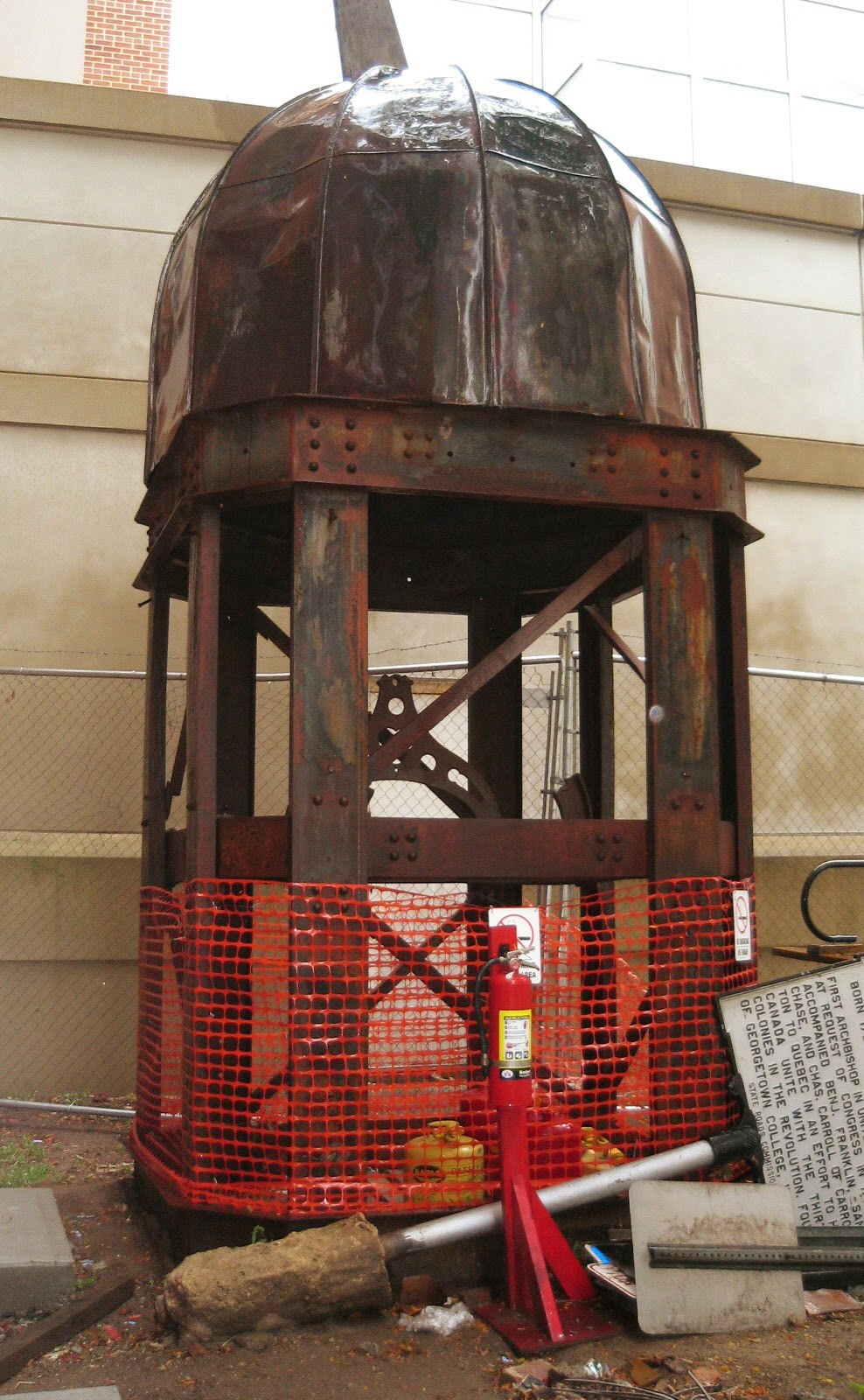
The historic 1939 Circuit Court building was devastated by fire in 2004, completely destroying the ornate Duvall Wing. The old bell tower that was atop the portico entry had been reduced to the structural frame and the historic bell within had crashed down to the ground during the fire.
The cupola's 124-year-old bell fell through the second floor during the fire and was buried in the rubble. (photo: Mark E. Brady -- Prince George's County Fire/emergency Medical)
For a number of years, during the renovation of the courthouse, the bell tower structure continued to deteriorate on what had become a construction site for both the courthouse expansion and the renovation of the damaged courthouse.
The structural remains of the original 1939 bell tower cupola.
In 2008 Prince George's County asked two of the artists that had made artwork for the interior of the Marbury Wing court expansion to collaborate and come up with some concepts for the front entry courtyard of the refurbished court building as it neared completion; Washington Glass Studio and Alonzo Davis. Early on, the decision was made to restore the original bell tower cupola as the centerpoint of the public artwork sculpture, and that informed the many design concepts explored. Infill panels made of cast glass with courthouse/legal imagery, sandcarved glass infill panels, backlighting with computer controlled LED panel lighting effects, neon lighting - were some of the many different ideas that were explored and the design options were narrowed down, documented and presented to the courthouse committee, headed by Circuit Court Judge Sheila Tillerson-Adams.
Different concepts of integration of lighting and cast recycled glass were explored.
Titled "Rebirth and Renewal ", the concept was modified with input from the judges and the committee, and in late 2009, the original steel structure and copper dome top was restored and set into a new paved area outside the courthouse, near the main courthouse entry. Glass began being cast into bas-relief panels with imagery based on the courts, the legal system, Prince George's County, and the original court building.

Cast bas-relief panels made from recycled glass were made with court and community based imagery. Michael Janis begins coldworking the panels. Nicole Puzan installs the cast textured panels into the steel framework.
Steel frames were made for the glass panel infill support. Neon artist Marty King made a neon representation of the original bell of the bell tower, which, by tradition, was struck at 9.30 am each day court was in session. An engineer certified the original bell tower cupola's structural integrity for the modifications and reuse. Custom benches for seating around the artwork were started. The chamfered corner panel infills were designed to incorporate detailed county seals representing the counties served by the Circuit Court. These panels were clear, with deep, intricate sandcarved panels. In December of 2009, all the elements were coming together, and installation of the cast glass began.

Erwin Timmers tests the neon. Erwin Timmers and Alonzo Davis bolt the infill panels to the steel structure.
During the installation, the Washington, DC area was hit by two snowstorms that dumped the largest amount of snow ever recorded in the area's history, and installation had to work around the snow removal efforts.


The names of the Circuit Court refurbishment committee are acknowledged in sandcarved panels mounted in the glass and steel sculpture. The cast recycled glass alternates with clear glass to allow alternating views looking into the neon bell sculpture and allowing diffused lighting from the neon to illuminate the cast glass symbols.

The final elements were recently installed, and the neon switched on. In the next couple of weeks, the professional photos of the cast glass public art sculpture will be taken by Anything Photographic - and we will post. The photos of the artwork are now online - Click HERE to jump to photos of the finished work.

13 November 2009

Food & Friends 'Friendship Wall'


The charity organization Food & Friends had commissioned the Washington Glass Studio to create its outdoor donor wall, located in the park adjacent to its Northeast Washington, DC facility. The wall is made of bas-relief cast glass, made in muted autumnal Bullseye glass colors, and set in a steel framework. The donor names are engraved on metal inset panels. The translucent panels allow for light and color to pass thru the memorial.

Food & Friends was founded to serve a distinct need in the community -- feeding those who are sick. This need persists and continues to grow. For more than twenty years, Food & Friends has been the only organization in the Washington metropolitan area to provide life-sustaining nutrition to our neighbors in need. For more information on Food & Friends and how you can help out - click HERE .
To order a delicious Thanksgiving Pie from Food & Friends - click HERE

photos by: Anything Photograhic

The Friendship Donor Wall opened this past September. Check out some of the architectural projects by the Washington Glass Studio - click HERE.

12 January 2009

'New Glass Review' features Washington Glass School artist

The Corning Museum of Glass hosts a yearly international review of glass in a publication from Germany called New Glass Review (Neues Glas).

This year's judges included Rachel Berwick, Department Head of Glass, Rhode Island School of Design, Providence, Rhode Island; Mieke Groot, independant curator, Amsterdam, The Netherlands; Tina Oldknow, the Curator of Modern Glass for Corning Museum, Corning, New York; and Dante Marioni, glass superstar, Seattle, Washington.

A total of 1,047 artists from 43 countries sent 2,974 images of work for consideration. Of these 100 were selected for inclusion in New Glass Review 30, and I am thrilled to be one of those 100! The publication is due in May, and the images will be part of the Corning Museum's Rakow Research Library.
Michael Janis